Things to Do in Boston Museum of Bad Art
 | |
| MOBA's location Prove map of Massachusetts Museum of Bad Art (the Usa) Evidence map of the United States | |
| Established | 1994 |
|---|---|
| Location | Dedham, Massachusetts (one-time; closed 2012) Somerville, Massachusetts Brookline, Massachusetts South Weymouth, Massachusetts |
| Coordinates | 42°fourteen′53″N 71°10′23″W / 42.248026°N 71.172969°W / 42.248026; -71.172969 Coordinates: 42°xiv′53″N 71°10′23″W / 42.248026°N 71.172969°West / 42.248026; -71.172969 |
| Type | Fine art museum |
| Director | Louise Reilly Sacco |
| Curator | Michael Frank |
| Public transit access | Somerville Gallery: MBTA Red Line Davis Station |
| Website | www.museumofbadart.org |



The Museum of Bad Art (MOBA) is a privately owned museum whose stated aim is "to celebrate the labor of artists whose work would be displayed and appreciated in no other forum".[1] It was originally in Dedham, Massachusetts and is currently in Somerville, Massachusetts.[2] Its permanent collection includes over 700 pieces of "art too bad to be ignored", 25 to 35 of which are on public display at any in one case.[3]
MOBA was founded in 1994, after antique dealer Scott Wilson showed a painting he had recovered from the trash to some friends, who suggested starting a collection. Inside a year, receptions held in Wilson's friends' dwelling house were so well-attended that the collection needed its own viewing infinite. The museum then moved to the basement of a theater in Dedham. Explaining the reasoning behind the museum'south establishment, co-founder Jerry Reilly said in 1995: "While every city in the world has at least one museum defended to the best of art, MOBA is the only museum dedicated to collecting and exhibiting the worst."[four] To be included in MOBA'southward collection, works must be original and accept serious intent, simply they must as well have significant flaws without being irksome; curators are non interested in displaying deliberate kitsch.
MOBA has been mentioned in dozens of off-the-beaten-path guides to Boston, featured in international newspapers and magazines, and has inspired several other collections throughout the world that fix out to rival its own visual atrocities. Deborah Solomon of The New York Times Magazine noted that the attending the Museum of Bad Fine art receives is function of a wider tendency of museums displaying "the best bad art".[5] The museum has been criticized for being anti-fine art, but the founders deny this, responding that its collection is a tribute to the sincerity of the artists who persevered with their fine art despite something going horribly wrong in the process. According to co-founder Marie Jackson, "We are hither to celebrate an artist's correct to fail, gloriously."[6]
History [edit]
The Museum of Bad Art was founded by antique dealer Scott Wilson, who discovered what has go the museum's signature piece—Lucy in the Field with Flowers—protruding from betwixt two trash cans on a Roslindale-surface area curb in Boston, among some garbage waiting to be nerveless. Wilson was initially interested only in the frame, but when he showed the film to his friend Jerry Reilly, the latter wanted both the frame and the painting. He exhibited Lucy in his home, and encouraged friends to look for other bad art and notify Wilson of what they found.[7] When Wilson acquired another "equally lovely" slice and shared it with Reilly, they decided to offset a collection. Reilly and his wife, Marie Jackson, held a party in their basement to exhibit the collection to date, and hosted a reception they facetiously titled "The Opening of the Museum of Bad Art".[8]
Regular showings of the pieces collected by Wilson, Reilly, and Jackson (and those donated by others), became too much for Reilly and Jackson's pocket-sized home in W Roxbury, Massachusetts, as hundreds of people attended the receptions.[9] The founders' initial attempt at dealing with their constrained exhibition space was to create the Virtual Museum Of Bad Fine art, a CD-ROM with a cast of 95 people that presented the MOBA art collection in a fictional imaginary museum.[10] This fictional MOBA allowed the visitors not only to view the paintings but to go behind the scenes in the fictional museum.
The MOBA was officially founded in 1993, and its first exhibition was presented in March 1994.[11]

2:14 by Kafka Liz (2009). The original stairwell entrance to the Museum of Bad Art and the men'south restroom
Word of the museum's collection continued to spread until, according to "Permanent Acting Acting Director" Louise Reilly Sacco, "it got completely out of mitt" when a group of senior citizens on a tour double-decker stopped to see it.[vii] In 1995 the display space was moved to the basement of the Dedham Customs Theatre, a building with an aesthetic described in 2004 every bit "ramshackle".[12] The museum in Dedham had no fixed operating hours, instead being open while the theater upstairs was open.[thirteen] As The Boston Globe notes, the art collection was appropriately placed "just outside the men'due south room",[14] where sounds and smells carry to the collection and the constant flushing of the toilet "supposedly helps maintain a uniform humidity", co-ordinate to the South China Morning time Post.[15]
In MOBA's early days, the museum hosted traveling shows; on one occasion the works were hung from trees in the wood on Greatcoat Cod for the "Art Goes Out the Window—The Gallery in the Wood". Bad music was played during the public viewings to complete the ambiance. In an exhibition titled "Awash in Bad Art", 18 pieces of art were covered in shrink wrap for "the world'south showtime bulldoze-thru museum and motorcar wash". Marie Jackson, formerly the Director of Aesthetic Interpretation noted, "We didn't put any watercolors in there."[6] A 2001 exhibition, "Buck Naked—Null Only Nudes" featured all of the MOBA nudes hung in a local spa.
MOBA features its works in rotating collections. In 2003, "Freaks of Nature" focused on landscape artwork "gone amiss". A 2006 exhibit titled "Hackneyed Portraits" was designed to "option up some of the slack" when the David Hockney show at Boston'south Museum of Fine Arts closed.[16] MOBA unveiled its testify "Nature Abhors a Vacuum and All Other Housework" in 2006; this format continues on the museum'southward website.
A 2nd gallery opened in 2008 at the Somerville Theatre in Davis Square, Somerville, Massachusetts, where the drove was placed well-nigh both the women'due south and men's restrooms.[17] Although the original gallery was free and open to the public, the second is free with access to the theater or with a laissez passer requested from the museum.[eighteen] Exhibitions titled "Bright Colors / Dark Emotions" and "Know What You Like / Paint How You Experience" have been held in the academic gallery at Montserrat College of Art in Beverly, Massachusetts.[19] One of MOBA's goals is "to take bad art on the route", according to Sacco.[xx] Pieces from MOBA'due south collection take been on display in museums in New York City, Ottawa, Taipei, and Virginia.[21] [22]
In Feb 2009, MOBA announced a fundraiser to assist the Rose Art Museum at Brandeis University, which was seriously considering whether to sell masterpieces because of the global fiscal crisis of 2008–2009, fabricated worse for the university by some of its donors losing money in Bernard Madoff'due south investment scheme. Current MOBA curator and balloon artist/musician Michael Frank placed Studies in Digestion—a four-console slice showing four renditions of the human digestive tract in various media past creative person Deborah Grumet—on eBay for a purchase-information technology-now price of $10,000; the first bid was $24.99.[14] It eventually sold for $152.53 and the meager proceeds went to the Rose Art Museum, while both museums gained publicity.[23]
In 2010, the museum opened a third location in the offices of the Brookline Interactive Group.[24]
In Dec 2012, the branch at the Dedham Community Theater airtight to convert the space into a screening room.[25] Some other co-operative later opened at the New England Wildlife Centre in Southward Weymouth.[26] During the COVID-19 pandemic, the locations in Brookline and Due south Weymouth closed, leaving just the location in Somerville.
Thefts [edit]
The loss of two MOBA works to theft has fatigued media attention and enhanced the museum's stature.[6] [27] [28] In 1996, the painting Eileen, by R. Angelo Le, vanished from MOBA. Eileen was acquired from the trash by Wilson, and features a rip in the canvas where someone slashed it with a knife even before the museum acquired it, "adding an additional chemical element of drama to an already powerful work", co-ordinate to MOBA.[29]
The museum offered a reward of $6.50 for the return of Eileen, and although MOBA donors later on increased that reward to $36.73, the work remained unrecovered for many years.[thirty] The Boston Constabulary listed the crime as "larceny, other",[six] and Sacco was reported saying she was unable to constitute a link between the disappearance of Eileen and a notorious heist at Boston'south famed Isabella Stewart Gardner Museum that occurred in 1990.[31] [32] In 2006, 10 years after Eileen was stolen, MOBA was contacted past the purported thief demanding a $5,000 ransom for the painting; no ransom was paid, simply information technology was returned anyway.[33]
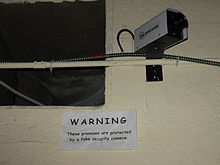
Prompted by the theft of Eileen, MOBA staff installed a fake video camera over a sign at their Dedham branch reading (in Comic Sans): "Warning. This gallery is protected past a fake security photographic camera".[34] Despite this deterrent, in 2004 Rebecca Harris' Self Portrait equally a Drainpipe was removed from the wall and replaced with a ransom notation demanding $10, although the thief neglected to include whatsoever contact data.[35] Shortly after its disappearance the painting was returned, with a $ten donation.[36] Curator Michael Frank speculates that the thief had difficulty fencing the portrait because "reputable institutions reject to negotiate with criminals."[36]
Collection standards [edit]
Although the museum'due south motto is "Art as well bad to be ignored", MOBA holds rigorous standards as to what they will accept. Co-ordinate to Marie Jackson, "Nine out of ten pieces don't become in because they're peachy enough. What an artist considers to be bad doesn't always meet our low standards."[37] Equally stated in the introduction to The Museum of Bad Fine art: Masterworks, the principal attribute of an objet d'art to be acquired by MOBA is that information technology must have been seriously attempted by someone making an artistic statement. A lack of creative skill is not essential for a piece of work to be included; a prospective painting or sculpture for the drove ideally should "[outcome] in a compelling image",[38] or every bit honorary curator Ollie Hallowell stated, the art must have an "Oh my God" quality.[14]
An important criterion for inclusion is that a painting or sculpture must not be dull. Michael Frank says they are non interested in commercial works like Dogs Playing Poker: "We collect things made in earnest, where people attempted to make art and something went wrong, either in the execution or in the original premise."[xiv] Montserrat College of Art used MOBA'due south exhibition as a demonstration to its students that "sincerity is all the same important, and pureness of intent is valid".[39]
MOBA accepts unsolicited works if they meet its standards. Oftentimes, curators consider works past artists who brandish an intensity or emotion in the art that they are unable to reconcile with their level of skill. The museum defended a testify to "relentless creativity" in an exhibition titled "I Simply Can't Cease" that was covered by local news and CNN.[40] Other artists are clearly technically proficient, only attempted an experiment that did non end well.[41] Michael Frank has compared some of the works at MOBA with outsider fine art or fine art brut; some MOBA artists' works are too included in other galleries' outsider collections.[42] Dean Nimmer, a professor at the Massachusetts College of Fine art (as well holding the title of MOBA's Executive Director of Good Taste), noted the parallels between the Museum of Bad Fine art's standards and those of other institutions: "They have the model of a museum of fine arts and use the same kind of criteria to acceptance for bad piece of work ... [Their rules] are very like to a gallery or museum that says 'Well, our area is really installation art or realist paintings or neo-post-modern abstractions.'"[21]
MOBA does not collect art created past children, or fine art traditionally perceived as lesser in quality, such every bit black velvet paintings, paint-by-numbers, kitsch, or manufacturing plant-produced art—including works specifically created for tourists. Curators are as well not interested in crafts such as latch hook rug kits.[43] MOBA curators propose that more than advisable venues for such works would be the "Museum of Questionable Taste, The International Schlock Collection, or the National Treasury of Dubious Dwelling Decoration".[38]
The Museum of Bad Art has been defendant of beingness anti-fine art, or taking works that were sincerely rendered and mocking them. Nonetheless, Scott Wilson insists that a work of fine art accepted into MOBA is a celebration of the artist'due south enthusiasm.[21] Marie Jackson reiterated this thought, saying "I remember it's a neat encouragement to people... who desire to create [and] are held back by fearfulness, and when they run into these pieces, they realize there's cipher to be afraid of—just go for it."[44] Louise Reilly Sacco agreed, stating, "If we're making fun of something, information technology'due south the art community, non the artists. But this is a real museum. It's ten years. It'due south six,000 people on a mailing list. It's recognition all over the earth."[28] Curators insist that artists whose works are selected by MOBA savor the attention and that it is a win-win; the museum gains another work of fine art, and the creative person receives exposure in a museum. A 1997 article in The Chicago Tribune stated that none of the 10 to 15 artists who had stepped frontward to admit their work in MOBA had been upset.[44]
Many of the works in MOBA are donated, often by the artists themselves. Others come from yard sales or austerity stores; the Trash Collectors Union in Cambridge, Massachusetts has donated works rescued from imminent demise. Occasionally a painting may be purchased; at one time MOBA'due south policy was not to spend more than $6.50 on any piece.[half dozen] More recently, twice and even iii times that amount has been paid for an exceptional work.[45] Those pieces not retained by the museum are included in a "Rejection Collection" that may be sold at auction. In the past, some proceeds went to the Salvation Army for providing so many of MOBA'south pieces; the museum itself ordinarily benefits from most auctions.[44]
Drove highlights [edit]
Each painting or sculpture MOBA exhibits is accompanied by a brief description of the medium, size, name of the artist, as well as how the slice was caused, and an assay of the work'southward possible intention or symbolism. Museums Periodical noted that the give-and-take accompanying each work would most likely accept almost visitors reduced "to hysterics".[46] The captions—described as "distinctly tongue-in-cheek commentaries" by David Mutch of the Christian Scientific discipline Monitor [4]—were primarily written by Marie Jackson, until the "dissolution of the MOBA interpretative staff"; the task was then taken over by Michael Frank and Louise Reilly Sacco.[47]
Lucy in the Field with Flowers [edit]
Many of MOBA'due south works generate extensive soapbox from visitors. Lucy in the Field with Flowers (oil on canvas past Unknown; acquired from trash in Boston) remains a favorite with the news media and patrons. Equally the first work acquired by the museum, Lucy is "a painting so powerful it commands its own preservation for posterity", setting a standard by which all future acquisitions would be compared, and causing MOBA'south founders to question if Scott Wilson plant Lucy or she found him.[48]
Kate Swoger of The Montreal Gazette called Lucy a "gorgeous error", describing her thus: "an elderly woman dancing in a lush spring field, sagging breasts flopping willy-nilly, as she inexplicably seems to hold a cerise chair to her behind with one mitt and a clutch of daisies in the other".[34] Author Cash Peters, using less florid language, summarized it equally "the old adult female with an armchair glued to her donkey".[49]
MOBA'south argument nearly Lucy reads: "The motion, the chair, the sway of her breast, the subtle hues of the sky, the expression on her face up—every item combines to create this transcendent and compelling portrait, every detail cries out 'masterpiece'."[l] The Times recounted comments left by a museum visitor regarding the "countless layers of mysteries" the image offers: "What is Norman Mailer'due south caput doing on an innocent grandma's trunk, and are those crows or F-16s skimming the hills?"[51]
Lucy 's granddaughter, a Boston-expanse nurse named Susan Lawlor, became a fan of MOBA after seeing the portrait in a paper.[fifty] She recognized it every bit her grandmother, Anna Lally Keane (c. 1890–1968); upon seeing the motion-picture show, Lawlor snorted Coca-Cola from her nose in astonishment.[52] The painting was commissioned by her mother, and it hung in her aunt'south house for many years, despite the trepidation family members felt at seeing the last composition. Says Lawlor: "The face is hauntingly hers, simply everything else is then horribly wrong. It looks similar she just has i chest. I'chiliad not sure what happened to her arms and legs, and I don't know where all the flowers and yellow sky came from."[44]
Lord's day on the Pot with George [edit]
Sunday on the Pot with George (acrylic on canvas by John Gedraitis; donated past Jim Schulman) has been deemed "iconic" past Bella English of The Boston Globe, who assures the work is "100 percent guaranteed to make you outburst out laughing".[8] Wilson has pointed to George as an example of a technically well-executed piece of art using a bailiwick not usually seen rendered in paint.[44]
Many admirers of the first work donated to MOBA are hypnotized by the image of a portly man wearing "Y-front" underwear while sitting on a bedroom pot, in pointillist impressionism similar to the style of Georges Seurat. One critic speculates the pointillist fashion in George may have been acquired "from watching too much Boob tube".[53] The title refers to the Stephen Sondheim musical Sunday in the Park with George, which contains a dramatic recreation of Seurat's painting A Sun Afternoon on the Isle of La Grande Jatte. Author Amy Levin suggests that George is a pastiche of Seurat'southward painting.[54] The subject of this painting has been "tentatively identified" by the Annals of Improbable Research—the creators of the Ig Nobel honour—as John Ashcroft, one-time United States Attorney General.[55]
A visitor was so moved by George he felt compelled to limited his gratitude for its brandish in the Dedham Community Theatre basement, writing "Someone had slipped into the bathroom as I took in this painting and began peeing loudly into a toilet. The reverberating sound of urine splashing while viewing George brought the painting to life, and when the denouement of the affluent sounded, I wept."[56] MOBA'due south accompanying explanation introduces questions and observations: "Can the swirling steam melt away the huge weight of George's corporate responsibilities? This pointillist piece is curious for meticulous attention to fine detail, such as the stitching around the edge of the towel, in contrast to the nigh careless condone for the subject'due south anxiety."[57]
Bone-Juggling Dog in Hula Brim [edit]
In contrast to the pointillist impressionism of George, the museum also features a "fine example of labor-intensive pointlessism",[58] co-ordinate to MOBA staff. Mari Newman's Os-Juggling Dog in Hula Skirt (tempera and acrylic paint on canvas; donated by the artist), inspired this description by MOBA: "We can just wonder what possesses an artist to portray a canis familiaris juggling bones while wearing a hula skirt."[58] MOBA enjoys the mystery as much equally whatever other aspect of art, however.[15]
Newman, a professional person creative person from Minneapolis, responded to the curators' cogitation by describing how the epitome came into being. She bought used canvases while a poor fine art educatee, and was unsure how to use a canvas with these dimensions. Inspired by a cartoon of a dachshund, she chose that every bit a subject, but was unhappy with the effect until she added a hula brim she had seen in a magazine, and colored canis familiaris bones she spied in a pet shop. Newman wrote to them, saying "I almost threw information technology out until I heard of MOBA. Afterwards many years of slashing rejected work, now I wish I had saved them all for y'all."[59]
Motifs and interpretations [edit]
Travel writer Cash Peters identifies six characteristics mutual to many of the museum's artworks. The outset is that MOBA artists are unable to render hands or feet, and mask them by extending figures' arms off the canvass, hiding them with long sleeves, or placing shoes on anxiety in inappropriate scenarios. Second, Peters compared artists Rembrandt and J. Grand. Westward. Turner, masters of landscapes, who "could probably paint with their optics close" to MOBA artists who apparently did paint with their optics close, as skies are often painted in any color but blue, flora are created without reference to whatever existing constitute organisms, and fauna appear so small in the background it is impossible to discern what kind of animals they are. Third, MOBA artists apply perspective inconsistently, either from ane painting to the next, or within a single work. Peters's fourth observation concerns the difficulty MOBA artists seem to have in successfully rendering noses: he writes that a nose will exist attempted so many times that the work takes on a third dimension as paint is reapplied over and over. Fifth, bad artists favor "mixed media": if in incertitude, they glue feathers, glitter, or hair to their work. Lastly, Peters suggests that artists know their work is bad, but apparently feel the piece may exist saved by including a monkey or a poodle in the composition.[60]
Since late 2008, MOBA has been experimenting with allowing the public to title and caption some works. According to the curatorial staff, since some of the works are so puzzling, mere artistic estimation is non sufficient: they must exist "interpretated".[47] The "Guest Interpretator's Collection" is an invitation for MOBA'south visitors to include their thoughts on compelling artworks; a contest decides the best assay and these interpretations are added every bit each competition ends.[61] A professor at Boston University offered his thoughts: "The location of the museum as much every bit its collection suggests a commitment to the apple-polishing and a conventionalities in the ability and force of civilisation's marginalized effects. I was also reminded that I need to pick up some toilet bowl cleaner on my way home!"[8]
Influence [edit]
The Museum of Bad Art has been mentioned in hundreds of international publications, too as in Boston-area travel guides highlighting offbeat attractions. It has inspired similar collections or events in Australia,[62] Ohio,[63] and Seattle.[64]
Commedia Beauregard, a theatre company whose mission focuses on translation, was inspired past MOBA's mission to create their Master Works series of short play festivals. The visitor commissioned six playwrights to write brusk plays based on MOBA artworks. Master Works: The MOBA Plays was originally performed in Jan and Feb 2009 in Minneapolis, Minnesota. The plays were based on the MOBA pieces Mana Lisa, Invasion of the Office Zombies, My Left Foot, Bone-Juggling Dog in Hula Skirt, Gina'south Demons, and Lulli, Fowl and Gravestone.[65] After moving to Chicago, the company again produced The MOBA Plays in March and Apr 2011, using three of the original plays and translating three new paintings.[66]
Responses to bad art [edit]
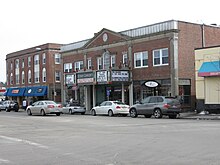
The Dedham Customs Theater housed the first MOBA gallery in its basement.[67]
Museum visitors can sign a guest volume, and leave comments. 1 Canadian visitor wrote: "This collection is disturbing, yet I tin can't seem to look abroad...Only similar a hideous motorcar accident." Another visitor warns: "Her nipples follow y'all effectually the room. Creepy!"[two]
Response to MOBA's opening and continued success is, for some, evocative of the way art is treated in society. MOBA works accept been described as "unintentionally hilarious", like to the atrocious films of Ed Wood.[68] Visitors—and even MOBA staff—oftentimes laugh out loud at displays. In Gullible's Travels, Cash Peters assorted this behavior with what is expected of patrons at galleries such as Southern California'south Getty Museum; though viewers might discover the art at the Getty equally hilarious, were they to bear witness it they would almost certainly be thrown out.[69]
In 2006, Louise Reilly Sacco participated in a panel give-and-take with government on art and compages nigh standards of beauty and ugliness in fine art, published in Architecture Boston. She remarked that teachers bring high schoolhouse art students to MOBA, then to the Museum of Fine Arts, Boston (MFA). Sacco observes, "Somehow MOBA frees kids to laugh and point, to have their own opinions and contend most things. And then they have the experience to the MFA, where they might otherwise feel intimidated... Possibly the ugly ... frees us."[41] Sacco believes that extreme ugliness is more striking than extreme dazzler, and it forces people to recall more deeply nigh what is wrong or misplaced. She connects this rigid judgment of what does not adapt to beauty with intolerance for concrete imperfections in people, noting that such rigidity sometimes causes parents to "ready" the perceived flaws in their children's faces to continue them from suffering subsequently.[41]

Jason Kaufman, a Harvard professor who teaches the sociology of civilisation, wrote that MOBA is part of a social trend he calls "annoyism", where mass media venues promote performances and artists who mix the deliberately bad with the clever. The Museum of Bad Art happens to embody this trend, and further illustrates its central aim to mock the judgment system past which people identify what is bad from what is not. For Kaufman, "The beauty of MOBA—though dazzler is surely the wrong word—is the way it undermines aesthetic criteria from numerous angles."[seventy] Amy Levin, describing how American history and culture have been shaped by modest local museums, suggests that MOBA is a parody of art itself, and that MOBA's commentary, newsletter, website, and publications mock museums as authorities on what is good art.[54] The director of the Ellipse Arts Center, a gallery in Arlington, Virginia, that hosted a traveling exhibition of MOBA works, was astonished to encounter people'due south exuberant laughter because no one visiting the Ellipse had ever responded to fine art this way. She observed, "If I didn't have a sign on the door, people might not retrieve information technology'due south so bad. Who'south to say what'southward bad and what's adept?"[71]
Deborah Solomon, in The New York Times Magazine, asserted that MOBA's success reflects a trend in modernistic art amongst artists and audiences. The arrival of abstraction and modern art in the early on 20th century fabricated art appreciation more than esoteric and less accessible for the general customs, showing that "the American public ... remember[s] of museums equally intimidating places ruled by a cadre of experts whose sense of taste and rituals [seem] every bit mysterious every bit those of Byzantine priests."[5] Bad art is in vogue, as a motion that rejects the anti-sentimentalism that marked before disdain for artists such as Norman Rockwell or Gustave Moreau, according to Solomon. Garen Daly, a MOBA fan on several Boston-expanse art councils, stated in 1995, "I become to a lot of openings, and sometimes they're pretty damn stuffy."[39] Not just does the Museum of Bad Fine art offering different fare for the optics, only instead of the vino and cheese that is provided for most museum and art gallery visitors, a MOBA show provides its patrons with Kool-Aid, Fluffernutters and cheese puffs.[71]
Use in bookish research [edit]
The Museum of Bad Art has been used in academic studies as a standard of reference for the spectacularly awful. In one such written report, published in Perspectives on Psychological Scientific discipline, researchers tested the consistency of responses between people asked to make "gut" judgments versus those who gave conscious well-reasoned responses regarding the quality of various pieces of art. The researchers showed respondents images from MOBA and New York'south Museum of Modern Fine art (MoMA), and asked them to rate each painting on a calibration with two ends representing "Very Bonny" and "Very Unattractive". The study plant that those who reasoned in conscious thought were neither more than accurate nor as consistent in their ratings.[72] Study participants identified and rated MoMA art higher quality, but those who used conscious reasoning did not discover MoMA art more attractive than those who rated with "gut" judgments. Furthermore, the deliberators did not find MOBA art as unattractive as those with quicker response times. The study concluded that people who brand quick judgments do and so more than consistently, with no significant change to accuracy.[73]
In another study that appeared in the British Journal of Psychology, researchers tested how respondents considered balance in artwork composition of differing qualities. 15 pairs of works from ArtCyclopedia past artists such as Paul Gauguin, Georgia O'Keeffe, and Georges-Pierre Seurat, and fifteen from MOBA by artists including Doug Caderette, Unknown, and D. Alix were shown to participants; in each, an detail in the painting was shifted vertically or horizontally, and respondents were asked to identify the original. The researchers hypothesized that respondents would identify remainder and limerick more than easily in the traditional masterworks, and that study participants would observe a greater change of quality when items were shifted in traditional masterworks than they would in MOBA pieces. However, the study concluded that balance lonely did not ascertain art of higher quality for the participants, and that respondents were more likely to see that original art was more than counterbalanced than the altered version, not necessarily that the traditional fine art was significantly better composed and balanced than MOBA works.[74]
Run across also [edit]
- Museum of Especially Bad Art
Notes [edit]
- ^ Frank & Sacco 2008, p. vii
- ^ a b Piepenburg, Erik (September 22, 2010). "Loving the Lowbrow (Information technology Has Its Own Hall of Fame)". The New York Times.
- ^ Walkup, Nancy (March 2005). "ArtEd Online — NAEA in Boston — Reproducible Handout". School Arts. 104 (7): 36. ISSN 0036-6463. OCLC 1765119.
- ^ a b Mutch, David (November 2, 1995). "Art from the Bottom of the Heap: A 'Museum' Devoted to Bad Painting". The Christian Science Monitor. p. 13.
- ^ a b Solomon, Deborah. "In Praise of Bad Art". The New York Times, January 24, 1999
- ^ a b c d e "The Gallery of the Garish Masterpieces of Bad Fine art". The Irish Times, September 18, 1999. 9
- ^ a b Gaines, Judith. "Exhibiting Works of Trial and Error: Museum Finds Landscapes Gone Awry". The Boston Globe, May four, 2003. 9
- ^ a b c English, Bella. [1]. The Boston Globe, April 29, 2007. Reg7
- ^ Frauenfelder, Marker (July 1995). "Sheet Catastrophes". Wired.
- ^ DeJesus, Edmund X. (Jan 1996). "CD-ROM Review".
- ^ "Museum Of Bad Art Sense of taste Challenge". Artlyst. 18 Baronial 2011. Retrieved 2022-03-04 .
- ^ Citro & Foulds 2004, p. 114
- ^ Museum of Bad Art Archived 2013-01-02 at archive.today". Food & Wine Mag, October 2008
- ^ a b c d English, Bella. "Doing a Skillful Human action with Bad Fine art". The Boston Globe, February eight, 2009. Reg1
- ^ a b Wilson, David, "It May Be Fine art, But They Certain Own't No Oil Paintings". Southward China Morn Post, May 17, 2004. 5
- ^ Johnson, Carolyn. "And then Bad Information technology's Good: Dedham Museum Is Proud Home to Unforgettable Art That's Anything But Fine". The Boston World, June 25, 2006. one
- ^ Smykus, Ed. "Museum of Bad Art Volition Open Second Branch at the Somerville Theater" Archived 2012-09-17 at annal.today. Wicked Local, May 5, 2008
- ^ "Full general Info". Somerville Theatre. Retrieved on March 3, 2009.
- ^ Garcia-Fenech, Giovanni. "Bad Art Bonanza". New York City: artnet Worldwide, 2009. Retrieved on March 4, 2009.
- ^ Gray-Blanc, Elena. "The Practiced, the Bad... and the Very, Very Ugly — The Museum of Bad Fine art: A Worthwhile Stop on the Globe Weird Web". Santa Barbara Independent, September twenty, 2008
- ^ a b c Goldberg, Carey. "Arts In America: Fine art So Bad a Museum in Boston Relishes Information technology". The New York Times, October 14, 1998. E2
- ^ Hsiang-yi, Tang (January 5, 2014). "Everything but fine fine art". Taipei Times.
- ^ Bolton, Morgan Michele. "[2]". The Boston World, February 15, 2009
- ^ "Brookline Gallery". Museum of Bad Art. Museum of Bad Art. Archived from the original on 3 February 2016. Retrieved 19 January 2016.
- ^ "Museum of Bad Fine art (Gone)". Roadside America . Retrieved 19 Jan 2016.
- ^ "New England Wild fauna Center Gallery". Museum of Bad Art. Museum of Bad Art. Archived from the original on xvi January 2016. Retrieved xix Jan 2016.
- ^ Wulff, Julie "All Things Bad and Beautiful". The Boston Globe, December 13, 2006. SID2
- ^ a b Cobb, Nathan. "In Dedham, This Museum is Exhibiting 'Bad" Taste". The Boston Globe, Feb 28, 2004. C1
- ^ Portraiture #nine Eileen Archived 2015-02-24 at the Wayback Machine. Museum of Bad Fine art, 2009. Retrieved on March 8, 2009.
- ^ Belanger, Moran & Sceurman 2008, p. 59
- ^ Wright, Chris. "Framed: Adept times for bad art," Archived 2011-06-05 at the Wayback Machine The Boston Phoenix, April 25 – May 1, 2003
- ^ Kurkjian, Stephen. "The Gardner Heist", The Boston Globe, March 13, 2005
- ^ Frank & Sacco 2008, p. xi
- ^ a b Swoger, Kate. "Art Only a Mother Could Dearest: No Film is Too Imperfect for Massachusetts Museum". The Gazette, Montreal, Quebec, February 13, 2000. H6
- ^ Frank & Sacco 2008, p. xii
- ^ a b Michael Frank, "Art Theft Hits Home in Dedham", letter to the editor, The Boston Earth, February eleven, 2006. 10
- ^ Swoger, Kate. "Bad Art Finds a Expert Home at This Anti-Museum". Ottawa Citizen, February 26, 2000. K6
- ^ a b Frank & Sacco 2008, p. x
- ^ a b Hirsch, James "Gosh, That'southward Atrocious! Information technology Would Look Nifty Hanging in a Museum—Painting Failures Are Displayed on Some Walls in Boston Dedication to 'Bad Art'." The Wall Street Journal, July 12, 1995. A1
- ^ The MOBA news: The Museum of Bad Art (MOBA) Newsletter, Outcome #36 Excerpt Archived 2009-01-23 at the Wayback Machine. Museum of Bad Fine art, 2009. Retrieved on March 8, 2009.
- ^ a b c Architecture Boston (May 2006), Pretty Ugly (PDF), pp. 18–24, archived from the original (PDF) on 9 January 2011
- ^ The Museum of Bad Art'southward Michael Frank Off Center (2009). Accessed, March 31, 2009.
- ^ Frank & Sacco 2008, pp. x–eleven
- ^ a b c d e Caro, Mark, "Non a Pretty Movie—Boston-Surface area Museum a Monument to the Absolute Worst in Art". Chicago Tribune, May 20, 1997. ane
- ^ Belanger, Moran & Sceurman 2008, p. 158
- ^ Lewis, Jamie (May 2006). "Museum of Bad Art, Boston". Museums Journal. 106 (v): 62.
- ^ a b Frank and Sacco, xiv
- ^ Stankowicz & Jackson 1996, p. 82
- ^ Peters 2003, p. 67
- ^ a b Portraiture #ane Lucy In the Field With Flowers Archived 2009-02-26 at the Wayback Machine. Museum of Bad Art, 2009. Retrieved on March 4, 2009.
- ^ "So Bad It'south Proficient: The Arts Online". The Times, March 25, 2006. 15
- ^ Stankowicz & Jackson 1996, p. 2
- ^ Citro & Foulds 2004, p. 115
- ^ a b Levin, 198
- ^ "The George / John Controversy". Annals of Improbable Inquiry. Archived from the original on September 28, 2011. Retrieved March iii, 2009.
- ^ Stankowicz & Jackson 1996, p. 97
- ^ Portraiture #2 Lord's day on the Pot With George Archived 2009-02-26 at the Wayback Machine. Museum of Bad Art, 2009. Retrieved on March iv, 2009.
- ^ a b "Juggling Dog in Hula Skirt Archived 2009-05-02 at the Wayback Machine". Museum of Bad Art, 2009. Retrieved on March iv, 2009.
- ^ Frank & Sacco 2008, p. 52
- ^ Peters 2003, pp. 71–72
- ^ "The Invitee Interpretator'southward Drove Archived 2009-02-08 at the Wayback Machine". Museum of Bad Art, 2009. Retrieved on March 3, 2009.
- ^ Museum of Particularly Bad Art. Museum of Particularly Bad Art, 2009. Retrieved on March three, 2009.
- ^ MOBA Newsletter Archived 2009-04-04 at the Wayback Machine. Museum of Bad Art, Dec 1, 1999. Retrieved on March 4, 2009.
- ^ Ingham, Alison. "Museum Offers Eyeful of Bad Art" Archived 2013-12-28 at the Wayback Car. North Seattle Herald-Outlook, November nineteen, 2008. Retrieved on May 30, 2012.
- ^ "THEATER | "Master Works" at the BLB: Bad art, practiced plays".
- ^ "Archived copy". Archived from the original on 2014-03-14. Retrieved 2014-03-fourteen .
{{cite web}}: CS1 maint: archived re-create as championship (link) - ^ English, Bella. "Museum of Bad Art loses space in Dedham to exhibit its stuff", The Boston Earth (Jan. 12, 2013).
- ^ "Exhibit Preview: The Museum of Bad Art" Archived 2008-07-twenty at the Wayback Motorcar. Fast Forrard Weekly, September 17, 1998
- ^ Peters 2003, p. 68
- ^ Kaufman, J. (2007). "Then bad it's good". Contexts. half dozen (4): 81–84. doi:10.1525/ctx.2007.half dozen.iv.81. S2CID 60526033.
- ^ a b Lewis, Nicole. "For Badness' Sake". The Washington Mail service, Oct eight, 1998. D5
- ^ Dijksterhuis, A.; Nordgren, Fifty. F. (2006). "A Theory of Unconscious Thought". Perspectives on Psychological Science. ane (ii): 95–109. CiteSeerX10.ane.1.513.2448. doi:ten.1111/j.1745-6916.2006.00007.ten. PMID 26151465. S2CID 7875280.
- ^ Nordgren, Fifty. F.; Dijksterhuis, A. (2009). "The Devil is in the Deliberation: Thinking Too Much Reduces Preference Consistency" (PDF). Periodical of Consumer Research. 36: 39–46. doi:10.1086/596306. hdl:2066/77301.
- ^ Vartanian, O.; Martindale, C.; Podsiadlo, J.; Overbay, S.; Borkum, J. (2005). "The link between composition and balance in masterworks vs. Paintings of lower artistic quality". British Journal of Psychology. 96 (4): 493–503. doi:10.1348/000712605X47927. PMID 16248938.
References [edit]
- Belanger, Jeff; Moran, Mark; Sceurman, Mark (2008). Weird Massachusetts: Your Travel Guide to Massachusetts'southward Local Legends and Best Kept Secrets. Sterling Publishing. ISBN978-1-4027-5437-1. OCLC 179788920.
- Citro, Joseph A.; Foulds, Diane E. (2004). Curious New England: the unconventional traveler's guide to eccentric destinations. University Press of New England. ISBN978-one-58465-359-2. OCLC 55591139.
- Frank, Michael J.; Sacco, Louise Reilly (2008). Museum of Bad Art: Masterworks. Berkeley: Ten Speed Press. ISBN978-1-58008-911-i. OCLC 182621558.
- Levin, Amy K. (2007). Defining memory: local museums and the construction of history in America's changing communities. American Association for Land and Local History book serial. Rowman Altamira. ISBN978-0-7591-1050-2. OCLC 301935913.
- Peters, Cash (2003). Gullible's Travels: The Adventures of a Bad Sense of taste Tourist . World Pequot. ISBN978-0-7627-2714-8. OCLC 51534983.
- Stankowicz, Tom; Jackson, Marie (1996). The Museum of Bad Art: art also bad to be ignored. Riverside, New Jersey: Andrews and McMeel. ISBN978-0-8362-2185-5. OCLC 34640796.
External links [edit]

-
 Media related to Museum of Bad Fine art at Wikimedia Commons
 - Official website
- Dedham Community Theatre
- Somerville Theater
- Bad Taste Meets Bad Art: coverage of MOBA from Minnesota Public Radio
- Museum Spotlight: Museum of Bad Fine art: Coverage of MOBA from Museum Bookstore
Source: https://en.wikipedia.org/wiki/Museum_of_Bad_Art
0 Response to "Things to Do in Boston Museum of Bad Art"
ارسال یک نظر